
If you’re running a home cleaning business in Singapore, it can feel like you’re competing against a giant.
Urban Company has many of the advantages that smaller businesses don’t. It has funding, technology, a recognised brand and a platform that’s become familiar to many consumers. On the surface, it looks like an impossible competitor to beat.
It’s easy to look at a company like that and assume the only way to compete is to build something just as big.
But that’s rarely how markets work.
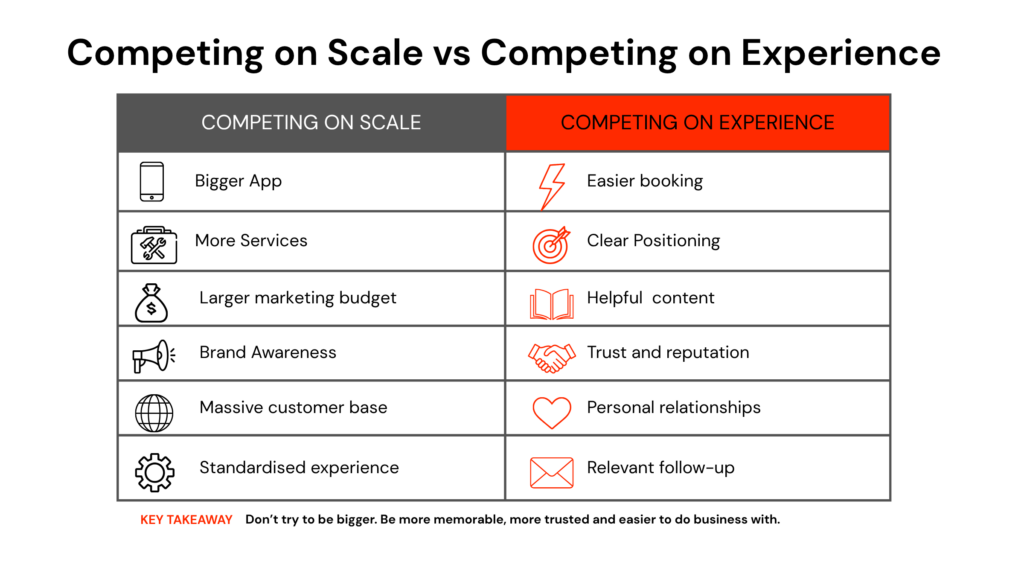
Large companies optimise for scale. Local businesses have the opportunity to optimise for something different. They can become more memorable, more trusted and more relevant to the customers they serve.
After more than 16 years working in advertising and marketing, one pattern has remained remarkably consistent. The businesses that outperform expectations are often the ones that stop trying to copy market leaders and instead become known for something distinctive.
If I were helping a home cleaning business position itself against Urban Company, these are the six areas I’d focus on.
Watch this blog on YouTube.
1. Stop Selling Cleaning. Start Owning a Mental Association
Most cleaning businesses describe themselves in almost identical ways.
They promise reliable cleaners, competitive prices, quality service and customer satisfaction. Those claims aren’t necessarily wrong, but they’re also difficult to remember because everyone says them.
The problem is that when every business competes on cleaning quality alone, customers are left comparing prices and reviews. That’s not a particularly strong position to be in.
Instead, think about the single idea you want customers to associate with your business.
Perhaps you’re the company that gives busy families complete peace of mind. Maybe you’re known for exceptionally fast response times, or for cleaners customers feel comfortable inviting into their homes. Perhaps your reputation is built around helping homeowners prepare effortlessly for guests or making move-out cleaning completely stress-free.
The specific idea matters less than the consistency with which you communicate it.
A useful exercise is to imagine asking one of your customers to describe your business in three words. If the answer is simply, “They’re a cleaning company,” there’s still work to do.
The strongest brands occupy a clear place in people’s minds. They don’t try to own an entire category. They own one meaningful idea.
2. Make It Easy for People to Find You
The way people discover businesses has changed dramatically.
Google remains important, but it’s no longer the only place people look. Consumers increasingly ask AI assistants for recommendations, compare online reviews and browse multiple sources before they ever visit a company’s website.
That means your online presence extends far beyond your homepage.
Your reviews, your business listings, your articles, your videos and every useful answer you’ve published all contribute to how visible your business becomes. Search engines and AI systems reward businesses that consistently demonstrate expertise and maintain accurate, trustworthy information across the web.
Many business owners still think of their website as their digital storefront.
Today, your digital presence is really the collection of everything your business contributes online.
The businesses that are easiest to discover are usually the ones that have spent years answering customers’ questions before those customers were ready to buy.
3. Become the Trusted Expert
One of the biggest missed opportunities among home service businesses is the type of content they publish.
Most social media feeds become an endless stream of promotions, discounts and reminders to book.
The problem is that promotions don’t build authority. Education does.
Think about the questions homeowners ask every day. How do you remove mould in Singapore’s humid climate? How often should a sofa be professionally cleaned? Is professional cleaning necessary before returning a rental property? What’s the difference between regular cleaning and deep cleaning?
Each of those questions is an opportunity to demonstrate expertise.
Write articles that answer them. Record YouTube videos explaining common cleaning challenges. Show how your team works and explain why certain techniques produce better results than others.
People don’t expect you to give away everything for free. They simply want evidence that you know what you’re talking about.
When customers learn from your business before they buy from you, trust begins long before the first booking.
4. Invest in a Brand People Remember
One area where Urban Company has performed particularly well is branding.
Its signature purple has become instantly recognisable. When one of its professionals walks through a condominium or waits at a bus stop in uniform, people immediately know who they represent.
Every uniform becomes a moving advertisement. Every consistent visual element reinforces memory.
Many local service businesses underestimate how much these small details matter. Generic logos, generic uniforms and generic stock photography all blend into the background.
Recognition comes from repetition and consistency.
Choose colours that become associated with your business. Invest in professional photography featuring your actual team rather than stock images. Show friendly faces, clean uniforms and real interactions with customers.
Your logo is only one small part of your brand. Your brand is every impression someone forms before they ever decide to contact you.
5. Make Buying Ridiculously Easy
It’s tempting to assume Urban Company’s biggest competitive advantage is its app.
In reality, convenience isn’t about having an app. It’s about reducing friction.
As platforms expand, they often become more complicated. More services, more menus and more decisions can actually slow customers down.
Consumers are also experiencing a growing sense of app fatigue. Few people want to download another application simply to book a cleaner.
That creates an opportunity for smaller businesses.
Imagine a customer sending a WhatsApp message. An AI assistant responds immediately, answers common questions, provides a quotation, confirms availability and accepts payment online, all within a few minutes.
No downloads or unnecessary forms. No waiting until business hours.
Every additional click creates another opportunity for someone to abandon the booking.
The easier you make it to become a customer, the more customers you’ll convert.
6. Use Customer Data to Build Better Relationships
Many home service businesses spend most of their marketing budget trying to acquire new customers.
Yet some of their most valuable opportunities already exist inside their customer database. Every completed booking tells you something useful.
You know when someone last booked. You may know whether they have children or pets. You might know they’ve recently moved into a new home or that they regularly schedule a deep clean before Chinese New Year.
That’s valuable information because it allows your marketing to become more relevant. Instead of sending the same promotion to everyone, you can send timely reminders based on real customer behaviour.
A customer who hasn’t booked in six months receives a reminder that it’s probably time for another deep clean. A family that books before festive seasons hears from you a few weeks before demand increases.
That’s what first-party data is really about.
It’s not collecting more information for the sake of it. It’s using what you already know to provide better service and more relevant communication.
Businesses that consistently use customer data thoughtfully tend to build stronger loyalty because every interaction feels more personal.
Competing Differently
Urban Company will probably continue to grow, and that’s perfectly reasonable. Large platforms are exceptionally good at scaling operations across markets.
But local businesses don’t need to beat them at scale. They need to become easier to remember, easier to find, easier to trust, easier to buy from and easier to return to.
Those advantages don’t require enormous funding rounds or sophisticated technology platforms. They require clarity.
When customers remember you for something meaningful, discover helpful content you’ve created, recognise your brand in their neighbourhood, enjoy a frictionless booking experience and receive communication that’s genuinely relevant, they don’t simply become customers.
They become people who recommend you to others.
And for most local businesses, that’s still the most valuable competitive advantage of all.