


Walk through any supermarket today and you’ll notice a quiet shift in the way brands talk about themselves.
Breakfast cereals promote their protein content. Soft drinks highlight reduced sugar. Snack brands promise gut health. Skincare companies explain the science behind skin barriers, peptides and ceramides. Even products that were once positioned around taste or convenience are now making health claims.
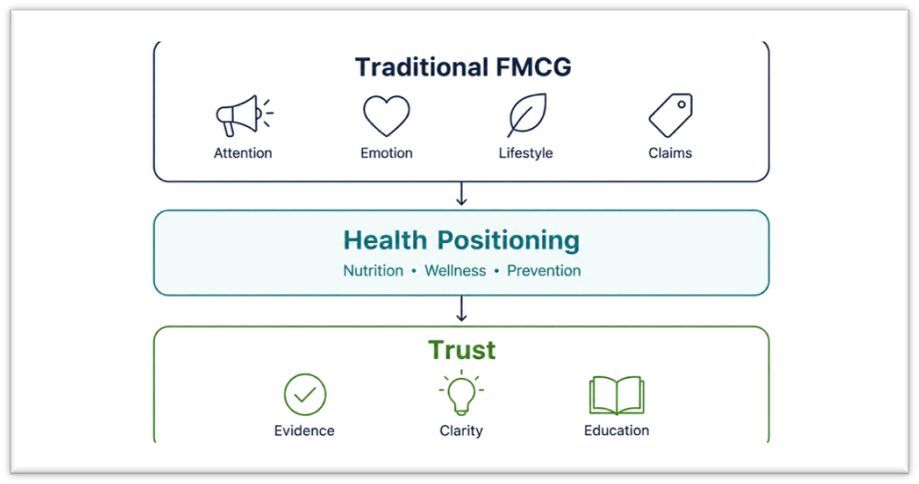
Health is no longer confined to hospitals, pharmaceutical companies or supplements. It’s becoming a positioning strategy across consumer markets.
That creates an interesting challenge. The moment a brand asks consumers to trust it with something related to their health or wellbeing, the rules begin to change. Traditional consumer marketing still matters, but healthcare marketing offers lessons that are becoming increasingly relevant for almost every category.
Having worked with some of the world’s largest healthcare brands, I’ve noticed that many of the principles healthcare marketers have relied on for decades are now becoming competitive advantages for mainstream businesses.
The interesting part is that these lessons aren’t limited to regulated industries. They’re becoming relevant anywhere consumers perceive risk. The greater the perceived risk, whether it’s financial, physical or emotional, the more people look for reassurance before they buy.
That’s why healthcare marketing has become such a useful blueprint for modern brand building.
1. Trust Is More Powerful Than Persuasion
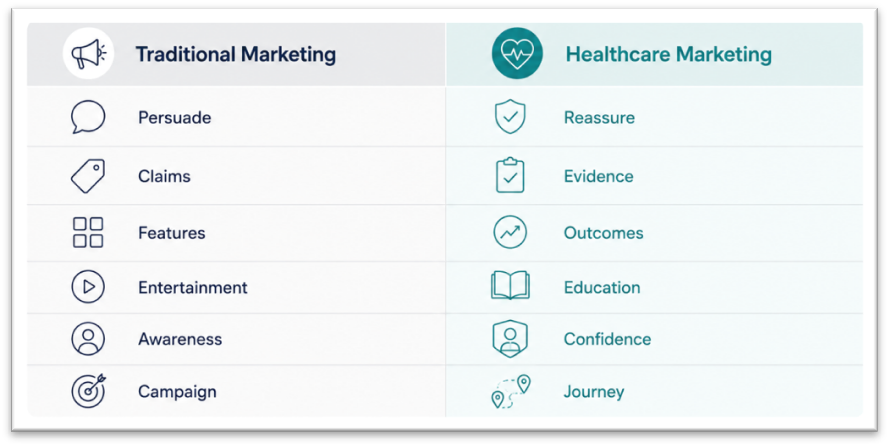
Much of traditional consumer marketing is designed to persuade. It captures attention, creates desire and encourages action. Healthcare marketing strategy operates differently because the stakes are higher.
Its primary job isn’t to persuade people. It’s to reassure them.
When people believe a product could affect their health, they naturally become more sceptical. They read ingredient labels. They compare alternatives. They search for evidence. Before they buy, they want reasons to believe the claims they’re seeing.
That’s why the loudest message rarely wins. The most believable one usually does.
For many marketers, this requires a shift in thinking. Instead of asking, “How do we make this claim sound more compelling?” the better question is, “What evidence would make this claim easier to believe?”
Those are very different creative briefs.
Evidence can take many forms: – Independent clinical studies, third-party certifications, transparent ingredient sourcing, expert endorsements, before-and-after data and customer outcomes.
Even explaining why a product may not be suitable for everyone can increase credibility because it signals honesty over hype.
This is one reason healthcare brands often communicate more cautiously than lifestyle brands. They understand that credibility compounds over time, while exaggerated claims create short-term attention but long-term scepticism.
As more brands move into health-related positioning, consumers are applying the same standards to everyone. A protein cereal isn’t only competing with other cereals anymore.
It’s being judged alongside specialist nutrition brands that have spent years earning trust.
That raises the competitive bar for everyone.
2. Translate Science Instead of Showing It Off
Healthcare is one of the most technically complex industries in the world. Yet the best healthcare marketing doesn’t overwhelm people with scientific terminology.
It does the opposite.
Great healthcare marketers take complicated information and explain it in ways that ordinary people can understand without sacrificing accuracy.
That’s becoming an increasingly valuable skill across consumer marketing.
Today’s products are filled with references to probiotics, collagen, amino acids, peptides, ceramides, fibre and electrolytes. While these ingredients may be important, most consumers aren’t trying to become nutritionists or dermatologists before making a purchase.
They’re asking a much simpler question:
What does this actually do for me?
One of the easiest mistakes marketers make is confusing explanation with education. Listing ingredients isn’t the same as explaining value. Consumers don’t buy probiotics because they’re probiotics. They buy the possibility of better digestive health. They don’t buy peptides because the ingredient sounds sophisticated. They buy healthier-looking skin.
The marketer’s job is to bridge those two ideas.
A simple framework can help:
- Start with the customer’s problem.
- Introduce the science only when it helps explain the solution.
- Finish with the practical outcome the customer can expect.
That sequence mirrors how people naturally process information. They care about themselves first, the science second.
Good healthcare branding doesn’t simplify by removing complexity. It simplifies by organising complexity into a story people can easily follow.
3. Information Is an Investment, Not Just Content
One of the defining characteristics of healthcare content marketing is the amount of educational material successful organisations create.
Healthcare brands invest heavily in articles explaining medical conditions, treatment guides, expert interviews, frequently asked questions, videos and patient education resources. These assets don’t exist simply to fill a website.
They exist because information reduces uncertainty.
When uncertainty goes down, confidence goes up.
Many brands still treat educational content as a supporting activity that sits beneath advertising. Healthcare marketers tend to see it differently. Information is part of the product experience itself.
Think about the questions customers ask before buying.
Is this ingredient safe?
How long does it take to work?
Who is this product designed for?
How does it compare with alternatives?
Every unanswered question creates friction. Every helpful answer removes a barrier to purchase.
That’s why healthcare content marketing often focuses less on publishing frequently and more on publishing comprehensively. A single well-written guide that genuinely answers customer questions can outperform dozens of short blog posts written simply to target keywords.
This way of thinking also changes how marketers measure content. Instead of asking how much traffic an article generated, ask whether it reduced uncertainty. Did it answer sales objections? Did it shorten buying decisions? Did it reduce customer support enquiries? Did it help prospects feel confident enough to move forward?
Those are business outcomes, not content metrics.
4. Build for AI Discovery, Not Just Search Rankings
Another reason healthcare marketers invest so heavily in educational content is that information now lives far beyond a company’s own website.
Consumers increasingly ask AI assistants questions that they once typed into search engines.
Which protein powder is best for beginners? Is creatine safe? What does collagen actually do?
AI doesn’t create trustworthy answers from nowhere. It synthesises information that already exists across reputable sources.
That means brands should think beyond keyword rankings and consider what I call “answer visibility.” If someone asks an AI a question related to your category, have you published the kind of content that deserves to inform that answer?
The brands that consistently explain, educate and cite credible evidence are likely to benefit as AI-powered discovery becomes a larger part of the customer journey.
In other words, your content isn’t only competing for clicks anymore. It’s competing to become part of the knowledge layer that influences buying decisions before customers ever reach your website.
Attention Starts the Conversation. Information Finishes It
None of this suggests that creativity or entertainment have become less important.
Great campaigns still capture attention. They make people stop scrolling. They create emotional connections and memorable brands.
But attention alone rarely closes the sale.
The most effective healthcare marketing strategy treats advertising as the beginning of a conversation, not the entire conversation.
An awareness campaign should naturally lead people towards deeper information. That might be a buying guide, an ingredient explainer, an expert interview, an interactive assessment or a comparison tool. Every piece should answer the next question customers are likely to ask.
This is where many brands leave value on the table. They invest millions generating demand, then expect a product page to do all the heavy lifting.
Healthcare marketers know better.
They build ecosystems of trust, where every touchpoint reduces uncertainty and reinforces confidence.
Healthcare Marketing Is Becoming Mainstream Marketing
Healthcare marketing has always operated under higher expectations because the consequences of poor communication are far greater.
When you’re communicating about people’s health, trust isn’t optional. Clarity isn’t optional. Useful information isn’t optional either.
What’s changing is that these expectations are no longer limited to hospitals, pharmaceutical companies and medical devices.
As more brands position themselves around nutrition, wellness and preventative health, they’re entering the same environment healthcare marketers have been navigating for decades.
The businesses that adapt first won’t necessarily be the ones making the biggest claims. They’ll be the ones that communicate with greater credibility, explain complex ideas more clearly and build systems that help customers make informed decisions long after the advertisement has ended.
Healthcare marketers have been learning these lessons for decades. The rest of marketing is finally catching up.