
Try this before you read any further. Open ChatGPT, Claude, Gemini, or wherever you get your freshly poured AI from, and ask it to recommend a business in your industry in Singapore.
Then see what comes back, and whether your business is on the list.
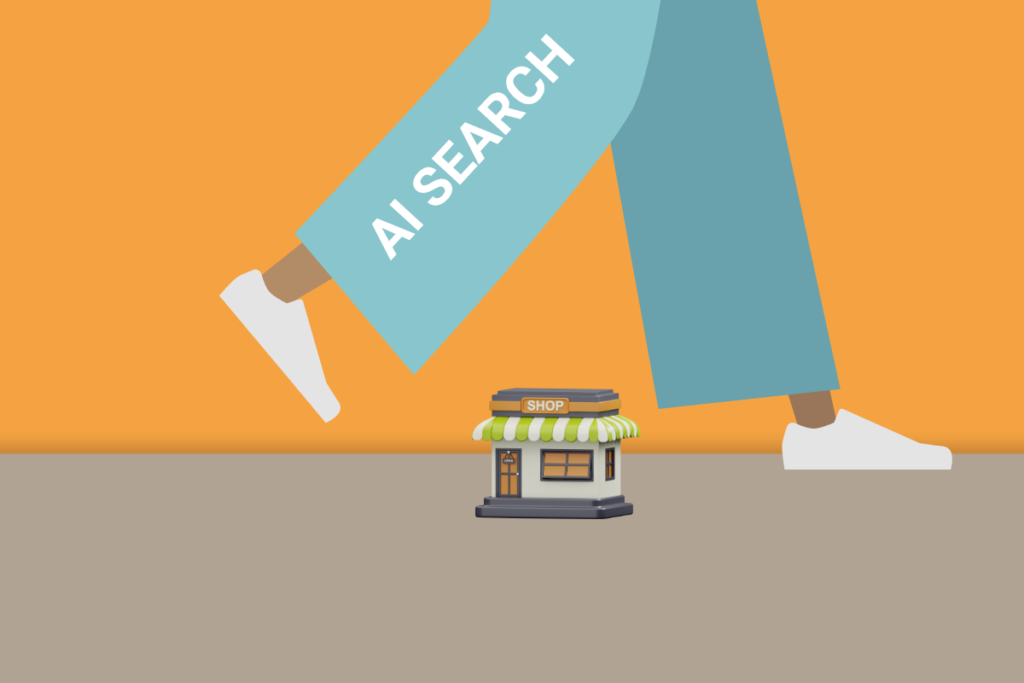
For many SME owners, the result may be surprising. A business can rank on page one of Google and still be largely invisible to AI search.
That’s no longer a hypothetical problem. It’s increasingly measurable, and the numbers are significant enough to change how businesses should think about their websites and theire online visibility.
Recently, The Business Times highlighted an interesting gap: Singapore SMEs have generally become much better at SEO, yet many remain largely absent from AI-generated recommendations.
So why is that happening? Is this a bias of smaller businesses being overlooked, or has the way people discover businesses simply changed faster than most companies have adapted?
The Numbers behind the Behavioural Shift
Just a year ago, only about 6% of consumers said they used an AI tool such as ChatGPT, Gemini or Perplexity to find a local business.
But in BrightLocal’s 2026 Local Consumer Review Survey, that figure had risen to 45% in twelve months. AI has already overtaken Yelp and TripAdvisor as a discovery channel and now sits behind only Google and Facebook.
The direction is increasingly clear. Pew Research conducted a behavioural study of nearly 69,000 real Google searches. When an AI Overview appeared, only 8% of users clicked through to a traditional search result. Without an AI Overview, that figure was 15%. Clicks on links contained within the AI summary itself were even lower, at just 1%.
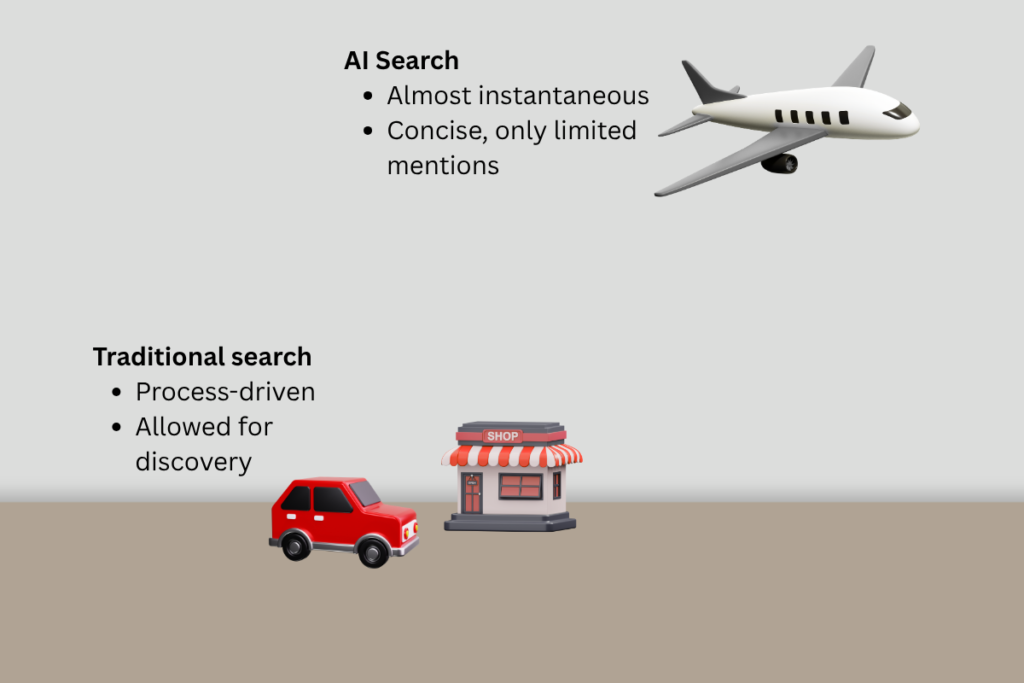
The traditional search journey we were used to, was relatively straightforward: search, compare links, visit websites and then decide.
But AI compresses that process. A user asks a question, the model narrows the field, and the decision may begin with just the tiny, tiny handful of businesses it chooses to mention.
That means education and information, and a lot of research process is happening before someone reaches your website. And in some cases, if they even reach your website at all.
Ranking and Being Recommended Are Now Two Different Games
This is where the distinction becomes particularly important for SMEs that have already invested heavily in SEO.
SOCi’s 2026 Local Visibility Index tracked more than 350,000 business locations across 2,751 brands. Those businesses achieved a 35.9% visibility rate in Google’s local 3-pack (If you’re wondering what that is – it’s the search feature that displays the top three local business listings alongside an interactive map when a user performs a search with local intent – Wayne)
But when it comes to searches through an LLM for example, ChatGPT recommended just 1.2% of the same locations.
The implication is significant. A business can perform well in Google’s local rankings and still have very little presence in AI-generated recommendations.
The reason is that Google rankings and AI recommendations are not necessarily assessing the same things.
Google traditionally rewards pages that align with keywords, search intent, authority and technical signals.
AI systems are also trying to establish something more contextual: who the business is, what it specifically does, who it serves and whether there is enough evidence elsewhere to support recommending it.
A page can therefore tick many of the traditional SEO boxes while still giving an AI system very little useful information about the business itself.
SEO asks whether Google can find and rank you. AI search increasingly asks whether a model can understand your business well enough to recommend you by name.
Those are related questions, but they are not the same test. Most SMEs have spent years optimising for the first one.
Your Website Now Has Three Readers
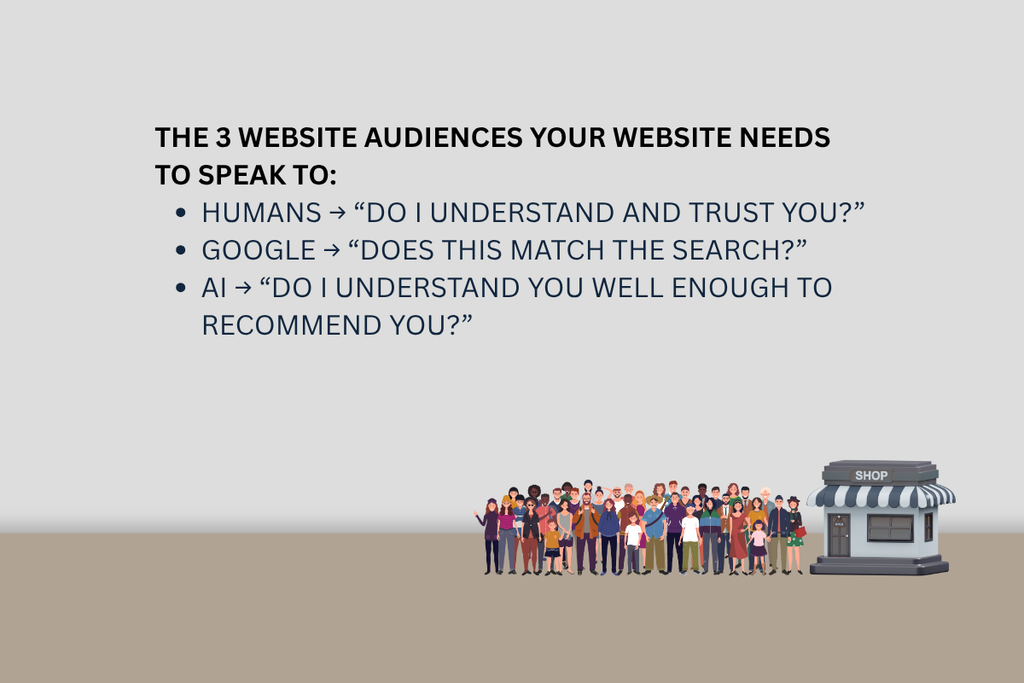
Most SME websites have traditionally been built for two audiences: people and Google.
But there’s now a third audience to consider, and it reads information differently from both.
People need to understand what you do, why you are relevant to them and why they should choose you.
Google needs structured, useful content that corresponds to what someone is searching for.
AI models need enough clear, specific and corroborated information to feel confident identifying your business as a credible answer to someone’s question.
A website that only satisfies the first two audiences may therefore be leaving an increasingly important visibility gap.
Generic Copy Is One of the Biggest Reasons Businesses Get Skipped
Consider a homepage that says something like: “We provide innovative solutions tailored to our clients’ unique needs.” That may sound polished, but it communicates very little that is concrete.
An AI model learns almost nothing about the company’s market, customer, service or area of expertise. From an information perspective, it is little more than white noise.
Now compare that with:
“We help Singapore SMEs redesign and rewrite outdated websites that are hurting enquiries.”
The wordcount is similar, but the information signal is completely different. A potential customer immediately understands who the service is for and what problem it solves. An AI model also has considerably more context when deciding whether the business is relevant to a particular recommendation.
Clarity is therefore becoming more than a copywriting preference. It is increasingly part of the technical information architecture of a website.
Vague, safe, committee-approved language is not only forgettable. It can also make a business harder for AI systems to interpret.
Omniscient Digital analysed more than 23,000 AI citations and found that a brand’s own website accounted for only around 23% of what AI models cited when answering questions about that brand.
The rest came from sources such as reviews, directories, press mentions and third-party coverage.
This makes the problem broader than website copy alone. If your own website is vague, and external sources (which are usually beyond your control) aren’t saying anything clear about you either, an AI model has very little reliable material from which to form a recommendation.
What Actually Moves the Needle
There is already plenty of generic advice telling businesses to “publish quality content” or “build their brand”. The more useful question is what the visibility research actually suggests businesses should do differently.
Keep your Google Business Profile complete and accurate: It remains an important source of structured information for local discovery. Inconsistent hours, addresses, categories or business information can reduce confidence in the data associated with your company.
Add structured data to your website: Schema such as LocalBusiness and FAQPage can give machines clearer, structured information about what a business does, rather than relying entirely on interpretation of the prose on a page.
Create a dedicated page for each important service: A single catch-all Services page may be convenient, but it often lacks the specificity needed for individual services to surface clearly in search or AI responses. A well-developed service page makes it easier for both customers and machines to understand exactly what you offer and where your expertise lies.
Build visibility beyond your own website: Directories, press coverage, review platforms and industry mentions are increasingly important because AI systems do not rely solely on what a company says about itself. Third-party references can help corroborate who you are, what you do and whether your business is credible.
Maintain a strong and consistent review profile: SOCi’s research found that recommended businesses typically maintained ratings comfortably above four stars, supported by a meaningful volume of reviews. A thin or inconsistent review footprint can make a business appear less established or less reliable than competitors with stronger third-party validation.
Answer the questions your customers actually ask: Your website should contain clear, useful answers written in natural language, rather than keyword-stuffed content designed primarily to satisfy an algorithm. The irony is that content written purely for machines increasingly performs poorly for people and may not give modern AI systems the contextual information they need either.
Now, none of these tips requires businesses to “game” AI. There are no quick shortcuts.
The fixes that do work though are largely about giving customers, search engines and AI systems clearer information to work with.
Do a 60-Second Test
There is a simple way to see what this looks like in practice.
If you haven’t already, open the AI tool you normally use and ask it to recommend businesses in your category and location. Make a note of the companies that appear.
Then look at what those businesses have in common. They may have stronger review profiles, clearer service pages, more third-party mentions, better structured information or a combination of all four.
That list may reveal something important: your competitive set in AI search could look very different from the businesses currently sitting beside you in Google’s rankings.
For SMEs, that is worth paying attention to now rather than a year from now.
SEO Isn’t Dead. It’s Just Not Enough on Its Own Anymore
Google search continues to drive substantial traffic and will remain an important acquisition channel for businesses.
This is not an argument for abandoning SEO. It’s an argument for recognising AI visibility as a second, related discipline with some different requirements.
Being easy to find and being easy to recommend are increasingly becoming two separate objectives.
Most businesses are still concentrating almost entirely on the first. That creates an opportunity for SMEs that begin adapting early.
The next battle for visibility may not simply be about reaching page one of Google. It may be about making the shortlist an AI model gives to a potential customer before that customer visits a single website.
Not sure what AI models are currently saying about your business?
That’s the kind of visibility gap we help SMEs identify and close at Everyone Creative, from understanding where you appear today to improving the copy, structure and third-party signals that influence whether your business gets named.
Get in touch with us on hello@everyonecreative.co and we’ll run the check with you.